


Simultaneous SIDS in Twins and Recent Immunizations
Simultaneous SIDS (SSIDS) is defined as “the death of twins which meet the defined criteria for sudden infant death syndrome (SIDS) independently and take place within the same 24 hour range.”
Throughout history there have been many examples of SSIDS which have been documented in case reports and case series. This review of the literature aims to organize this material chronologically and make it more readily available.
The first case report of twins dying suddenly and simultaneously does not fit the SSIDS criteria as these deaths occurred in 1945, more than two decades before the term SIDS would be proposed at the 1969 Seattle conference on sudden infant death. Rather than unexplained, or ill-defined, the twins’ collapse and subsequent deaths were attributed to anaphylactic shock due to a booster dose of vaccine.
This is a relevant contribution to the scientific literature of “crib deaths,” however, as Jacob Werne and his wife Irene Garrow would go on to publish extensively on the topic of sudden infant death (before it was a widely recognized public health issue) in New York, where Werne was an assistant medical examiner and his wife Irene was a forensic pathologist.
Study 1: Fatal Anaphylactic Shock: Occurrence in Identical Twins Following Second Injection of Diphtheria Toxoid and Pertussis Antigen. Werne and Garrow, 1946
Interval from vaccine: < 24 hours
Even though the twins’ deaths were determined by the pathologist of be a type of shock and anaphylaxis, they died the night and the next morning, respectively, of their second injection of the “double antigen vaccine.”
 About the infants: The twin boys were born at eight months gestation, D.M. weighing 2 pounds 8 ounces, and G.M. weighing 5 pounds 4 ounces. They were developing normally and in good health. At 6 months they were vaccinated against smallpox.
On June 19, 1945, the identical twins died after a second injection of diphtheria toxoid and pertussis antigen, alum precipitated, at 10 months of age. The first injections were given one month before (from another ampule of the same product). D.M. vomited, had a temperature of 101 F. and cried considerably.
After the second immunizing injections, both infants cried considerably on reaching home; they vomited and consumed excessive amounts of water, each taking about two full bottles. They then “fell asleep” and when next noticed by their parents appeared “lifeless.” D.M. had a “staring” expression; his temperature was 99 F. At 11:30 p.m. when his diaper was changed, he was found to be “ice cold and wringing wet with perspiration.” They did not seek medical attention and regarded the symptoms as expected effects of the injections. At 5:30 a.m. D.M. appeared to be dead and G.M. gravely ill.
Could the infants have died of water intoxication? Excessive water intake can be fatal, but the vaccine reaction preceded the water consumption, and there is no supportive laboratory findings for or against water intoxication. The autopsy showed extensive vascular pathology (not typical in water intoxication) which is one reason the authors argue for the systemic vascular collapse caused by anaphylaxis. Either way, anaphylaxis and water intoxication are not necessarily mutually exclusive. Many infants who experience vaccine reactions go on to do all sorts of things: in this case it may be drink excessive water, but in other cases it may be Tylenol or acetaminophen consumption, and in other situations, it may be co-sleeping. The infants showed immediate signs of an adverse reaction post immunization (crying, vomiting, excessive thirst, and fever and vomiting with prior dose), and died shortly thereafter.
Study 2: Simultaneous Sudden Death in Infancy and Identical Twins. Beal, 1973
Interval from vaccine: 3 weeks.
The male identical twins were born about 3 weeks early by elective cesarean, due to toxemia and high blood pressure (today we would call that preclampsia). The infants were low birth weight: 2.75 kg for twin 1 and 2.01 kg for twin 2.
“The babies were bottle fed with Enfamil until they were three months old, and from then on with cow’s milk.” (Cow’s milk inhibits iron absorption and can lead to anemia)
“Because of upper respiratory tract symptoms and signs, the babies’ inoculation against diphtheria, pertussis and tetanus was delayed and the first dose, together with oral poliomyelitis (Sabin) vaccine, was given three weeks before their death. After the inoculation and vaccination the second twin whimpered a little that night, while the first twin showed no noticeable effects.
Five days before the babies’ deaths, the mother developed a cold, and two days later the twins also developed slight colds, but on the day before they died they were happy, took all feedings well and their colds seemed almost better.
The babies slept in new cots with foam mattresses, one with a rubber and one with a foam crumb pillow, cotton sheets and new pure wool blankets. There was no carpet in the room.”
“The babies were usually put to sleep on their sides, more on the abdomen than the back, and were usually found in the morning on their abdomens, often having slipped down under the bedclothes.
On the night on which they died, both twins had been fed with commercially processed baby food, and a bottle of homogenized cow’s milk at 7 p.m., and the first twin had a further bottle of homogenized cow’s milk at 10 p.m, and 75 mg of acetylsalicylic acid at the same time.
At 5 a.m. the mother heard the second twin whimpering and went quietly to him, and so as not to disturb the other, took the second twin to the kitchen, changed his napkin, gave him his dummy and put him back to bed on his side, after which he seemed to settle. She did not notice whether the first twin was alive at the time.
When the father went to get the infants at 9.30 a.m., he noticed they were much further down their cots than usual, and when he pulled the covers off the first twin, he was lying on his abdomen, “black” and cold, and had obviously been dead for quite a long time. He then pulled the covers off the other baby and found him also lying face down, obviously dead, although not as “black” as the first twin, and still warm.”
Study 3: Simultaneous Sudden Infant Death Syndrome in Twins. Smialek, 1986.
A case series of 9 sets of twins who died simultaneously. Only two of the sets were examined by the author. Not all case histories mention immunizations or recent medical history.
Case 1 – 1976 – Identical twin African American male infants, 4 months of age were left sleeping in the prone position on a couch and were discovered hours later already deceased. They had been born prematurely, and had recently been seen by their family physician for “colds” and had been given decongestants. The infants were visited by a public health nurse who recommended the infants be placed to sleep on the couch, as it was firmer than the mattress they had been sleeping on. Results of hemoglobin electrophoresis indicated a sickle cell trait in each child.
Case 2 – 1981- Identical 9-week-old black male infants were found face down before noon. The infants had been born 2 months prematurely. The infants had not been recently ill and had not seen a physician since discharge from the hospital. The stomachs were empty and they weighed roughly 10 pounds, ruled as SIDS.
Case 3 – 1979 – Identical black male twins, 4 months of age, found face down in the sleeping area. Last fed at 11:30 pm, a parent heard coughing at 3:30 am, and the twins were found dead at 7:30 am, when their mother came home from work. The house was heated with an electric space heater, and the living conditions were described as deplorable. They were seen at 2 months of age for a routine examination. At death their weights were 4 kg and 3.3 kg, which is roughly 8 and 7 pounds respectively.
Case 4 – 1980 – Non-identical 5 month old twins, one male and one female, were found dead by their parents at 11 am. The infants were found in the same position as they had been placed after their last feeding after being fed their formulas after midnight. One was wearing a shirt, undershirt and corduroy trousers, and the other a soiled diaper, undershirt and sleeper. The boy was lying faceup and the girl was facedown. The twins had been seen in the clinic 2 weeks previously and had an appt. the next day. Since their release from hospital after birth they had been seen bi-weekly. The girl had a heart murmer.
Case 5 – 1980 – Non-identical twins, 2 1/2 months of age, were found dead in their crib in a basement apartment, positioned on their sides, back to back. The infants were white, full term, and delivered via cesarean section. They had been seen by their family physician at the age of 6 weeks for their initial immunizations. Case 5 occurred 4 days after Case 4, both in Milwaukee County (which seems incredibly odd).
Case 6 – 1981 – Identical white twin boys, 3 months and 23 days of age, were found dead in their bed, one hour after having been given their formula feedings. A week before death one twin was seen by emergency department for an elevated temperature and slight cough. The other twin was ill at the same time with a slightly elevated temperature and a rash. The infant was given oral antibiotics and antibiotic cream for conjunctivitis. For 3 weeks the family had been living in a steel-framed house heated with wood. Family history of SIDS.
Case 7 – 1967 – Identical twin girls, 5 months old, were found in infant seats position in a crib located within a mobile home. At 7 pm. prior to their deaths, the infants were fed a formula consisting of whole milk, water, and 1 teaspoon of Karo syrup. They arrived at the trailer park late that evening, and because it was cold in the trailer even after the oil burner started, the children were left fully clad. The parents awoke approximately 7:30 a.m. to find the trailer exceedingly warm and both infants dead. The sheriff noticed a strong odor of cooking gas material. The infants were in a separate portion of the trailer away from the cooking stove. Death determined to be natural causes, consistent with sudden death in infancy.
Case 8 – 1966 – Identical white male twins, 3 months of age, found facedown in their bed. They had been examined by the family doctor and pronounced normal approximately 2 weeks prior to death.
Case 9 – 1977 – Ghent Belgium – Twin white girls, 2 months of age, were found dead in their cribs. The pathologist stated he had been performing forensic autopsies for 25 years, and this case of simultaneous cot death was the first such example of this phenomenon that he had encountered.
Study 4: Vaccination and cot deaths in perspective. Roberts, 1987
Interval from vaccine: 2 hours
Written by a Wellcome Research Laboratories scientist S.C. Roberts, the vaccine maker funded paper tries to refute an association between vaccines (or just the DPT vaccine really) and SIDS, and simultaneous SIDS. The summary begins with the sentence:
“In 1985 twin boys simultaneously succumbed to sudden unexpected deaths two to three hours after vaccination with diphtheria, tetanus and pertussis vaccine (DTP).”
Even though the healthy infants died just a few hours after the shot, the author refutes any association between the vaccine and their sudden death. He does work for the exact vaccine maker that made the vaccine that potentially caused the death of the twins.
The research paper does not go into detail on the infants, it was written more as a a “medical perspective” review of the literature and refutation of the association.
What I could find about the particular infants from newspaper reports:
They were 5-month-old twins boys named Neil and Michael Clark (also spelled Michale in another newspaper). The fraternal twins were given their booster dose (second) of DPT vaccine and an oral polio vaccine on a sugar cube. They were tired and listless after the vaccines. Their mother placed them in their cot and they were found dead in their home in Leuchars, Fife, 2 hours after the shots.
The vaccine was Trivax brand, batch No. A57701 and the oral polio vaccine batch No. APTF 04115, both made by the Wellcome medical division. The government health department and the pharmaceutical giant Wellcome created an alert to locate the remaining doses of vaccine and ordered a halt of their usage immediately.
In the months after their deaths, many news articles then came out declaring no association between the immunizations and death, as the deaths were ruled as SIDS. But logic says that the odds of twins dying simultaneously two hours after vaccinations is inconceivably rare, especially given ‘the narrative that vaccines somehow reduce SIDS risk.’


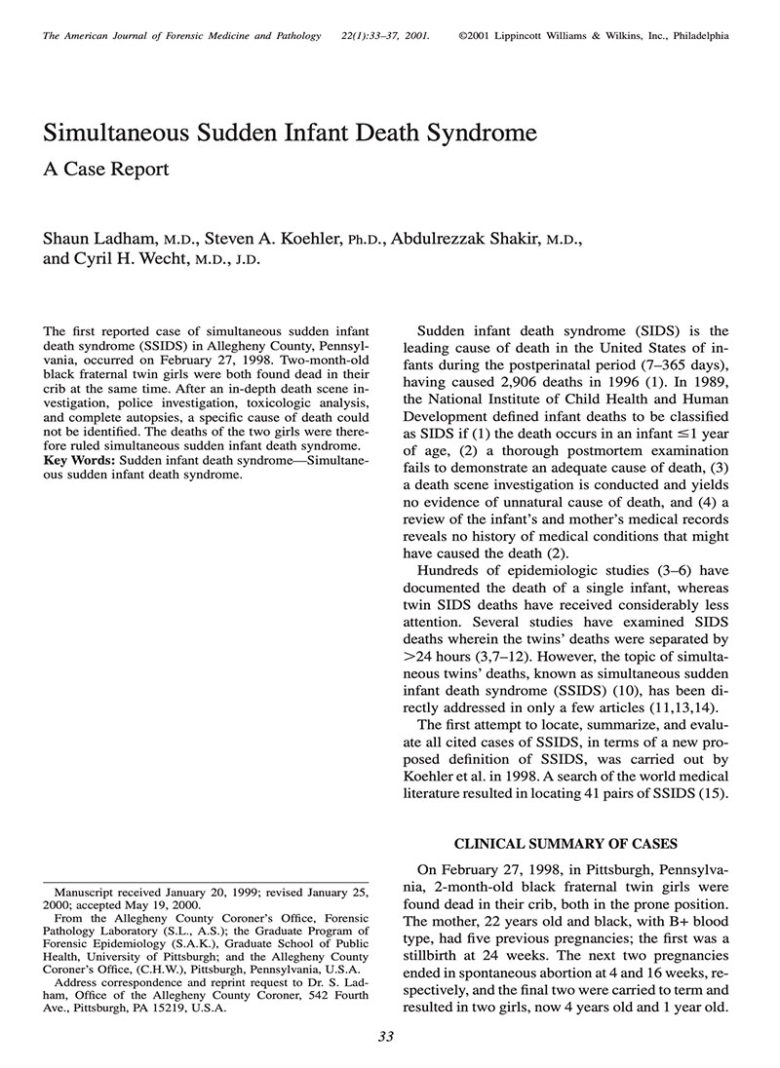
Study 5: Simultaneous sudden infant death syndrome: a case report. Ladham, 2001 Click for PDF
Interval from vaccine: 18 days.
The case study describes a pair of 2-month-old black fraternal twin girls found dead in their crib, both in the prone position. According to the case report, the mother was a smoker, and smoked half a pack of cigarettes a day during the twin pregnancy. Six days before delivery, the mother had a chlamydial infection which was untreated. The twins were born prematurely at 32 weeks gestation on December 3, 1997, and weighed about 4 pounds at birth.
The twin girls had well baby visits at 1 and 2 months of age. On February 9, 1998, the girls were seen for a well-baby visit where they were observed to have oral thrush and diaper rash, and were given their first immunizations.
On February 26, the twins were given a bottle of formula and put to bed in the supine position. At 1 am the infants were crying and the mother gave them a pacifier and left them to go back to sleep. When she checked on them at 11 am the next morning the twins were in the prone position and unresponsive.
Despite the infants being 8 weeks premature, they were vaccinated on schedule.

Study 6: Simultaneous sudden infant death syndrome. Balci, et al. 2007
Interval from vaccine: 2 days.
The twins are described as being recently vaccinated two days prior to being found lifeless. On the day of vaccination, the twins were also given a teaspoonful of acetaminophen, commonly known as Tylenol or Panadol.

“The case(s): Twin girls (3.5-month-old) were found dead by their mother in their crib, both in supine position. The infants were identical twins and delivered at a hospital by cesarean section. Both infants were healthy and did not have any serious medical history. Two days prior to the incident, the twins had received the second dose of oral polio, DPT and the first dose of hepatitis B vaccines and they had fever on the first day of the vaccination and been given teaspoonful of acetaminophen. Death scene investigation, judicial investigation, parental assessment, macroscopic and microscopic autopsy findings and the toxicological analysis did not yield any specific cause of death.
Study 7: Simultaneous sudden infant death syndrome: case report. Cevik, et al. 2010
Interval from vaccine: 3 days.
The case report describes a pair of 2 months and 8 days old twin male babies found dead in the supine position in their bed by their mother in Erzurum, Turkey. Just three days before their death, the twins received vaccinations against polio, diphtheria, pertussis, tetanus, and hepatitis b.

According to the case report:
“Both babies had been vaccinated the second doses of oral polio vaccine, diphtheria-pertussis-tetanus and hepatitis B three days before death. The first baby had high fever and was given a full teaspoon (~40 mg) of ibuprofen syrup by the mother. Later, the fever settled according to the mother’s description.
Read the full study here.
Study 8: Simultaneous sudden unexpected death in infancy of twins: case report. Mitchell, 2010 Click for PDF
Interval from vaccine: 5 days.
These infants had many overlapping risk factors which may make it difficult to identify what contributed to what: The infants were twins, their parents were smokers, they were recently vaccinated (5 days prior), they were given Tylenol, the young infants were sleeping with an adult-sized pillow.


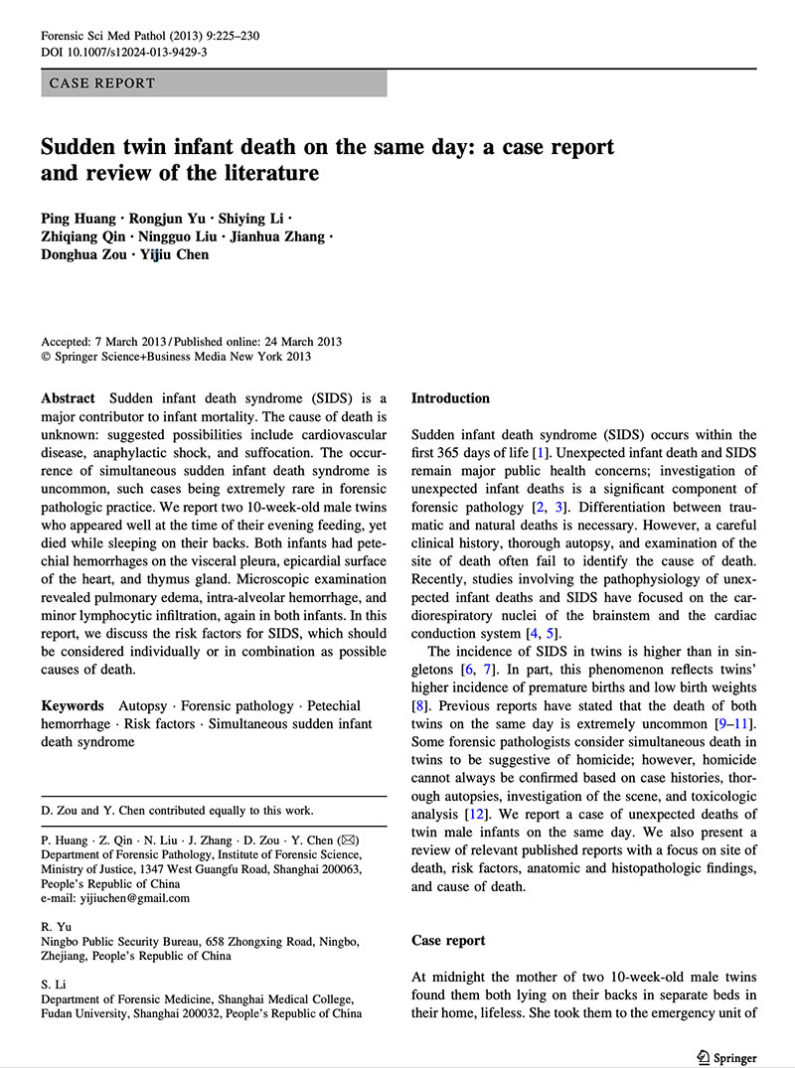
Study 9: Sudden twin infant death on the same day: a case report and review of the literature. Huang, et al. 2013 click for PDF
Interval from vaccine: 10 days.
The case report describes a pair of 10-week-old male twins found laying on their backs in separate beds in their home, deceased. The previous night, their mother fed them cow’s milk at 10 pm and put them to bed. They appeared normal.
Neither parents smoked cigarettes. Because the mother did not produce breast milk, the twins were fed cow’s milk since birth. The infants received their first doses of hepatitis B vaccine and bacillus Calmette-Guerin vaccines at the time of birth, and the first doses of oral polio and diphtheria, pertussis, and tetanus (DPT) vaccines 60 days after birth. They died at the age of 10 weeks, or roughly 70 days old. This suggests the twins died about 10 days after their vaccines.
Other information from the case report: the house was of poor quality, the police officer described the living conditions as deplorable. There was a coal stove in the twin’s bedroom.
Toxicological analyses revealed 8% (twin A) and 10.6% (twin B) carboxyhemoglobin in their blood.
(Cow’s milk inhibits iron absorption, and vaccine associated inflammation further alters iron homeostasis through hepcidin-mediated iron sequestration, reducing the oxygen carrying capacity of the blood. Altogether, all of these factors interacted and contributed to death.)

Study 10: Sudden infant death of monozygotic twin on the same day: a case report. Rayyan Al Ali, 2021.
Interval from vaccine: 2-3 days.
Eight-week-old female twins, well nourished and well cared for, were found dead in their sleep. They were breastfed dependent with extra artificial milk. They adhered to the recommended vaccination program in Palestine. They had already received the first dose of diphtheria, pertussis and tetanus vaccine (DPT), haemophilus influenzae type B vaccine (Hib) and oral polio vaccines (OPV). Authors “did not know the exact interval between last OPV dose and the date of death. However, according to the parents’ story it might be given 2 to 3 days before their death, as the 1st dose of OPV vaccine is usually given at the age of two months according to the Palestinian vaccination program.”
The twins were delivered by cesarean section after 34 weeks gestation. The father was a heavy smoker, although the mother was not a smoker at all.


